German · Years 2–4
Letters to Love
Why every child needs their own ABC
Please note: The alphabet conventions and examples in this article refer specifically to the German language and are intended for use in German-language primary school classrooms.
Anyone who works with primary school children knows: the alphabet is not simply a sequence. For many children — particularly in Year 1 — it is a difficult concept to grasp.
They do not learn letters alphabetically, but rather through a sound-based approach. And that is quite right. But it creates a problem later on: what does "sorting alphabetically" actually mean?
One card, many faces — but only one order.
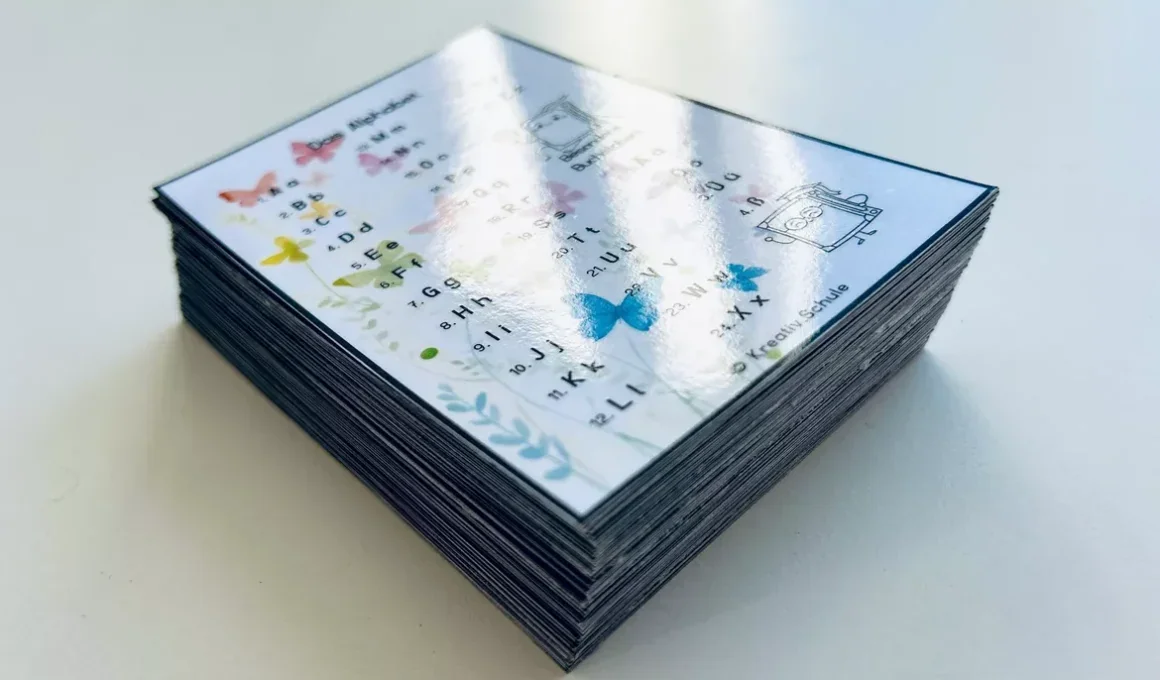
This is precisely where the alphabet card comes in: it shows the complete German alphabet — from A to Z, including the Umlauts Ä, Ö, Ü and the ß — numbered and visible at a glance. The card is available in 26 different designs, so that each child can choose their own version.
No "uniform grey", no forced aesthetic. Instead: choice, identification, self-determination.
This card is not a toy — it is a tool. A solid anchor in the everyday life of school.
And a quiet helper at the gateway to what will later be taken for granted: placing words in alphabetical order.
When is the right time?
The card is not suitable for children's first encounter with letters. In Year 1, children learn the alphabet not in sequence but through a sound-based approach — and rightly so. If you introduce A-B-C structures at that stage, you create more confusion than orientation.
The card is therefore ideally suited to Year 2, once most letters have been introduced and the focus turns to alphabetical order — that is, questions such as:
- What comes after M?
- What position does P occupy?
- How do I find a word in the dictionary?
Towards the end of Year 3 or the beginning of Year 4, all of this becomes relevant for sorting words — that is, for purposeful work with index cards, word lists, or reference books. And this is precisely where the small card becomes a genuine tool.
Why 26 designs?
Simply because not every child likes butterflies. Or robots. Or rainbows.
And because what we give children should be more than a working aid — it should be a small form of belonging. "That is my alphabet!" say pupils when they have chosen their favourite card. And yes, that is a good beginning.
Because when learning acquires a personal connection, the willingness to engage with it grows too. Identification is an underestimated driver in early teaching.
And this is not about frills, but about a deep form of self-efficacy: I am allowed to decide. I am seen.
And whoever has chosen their own materials engages with them differently.
- Ideal for Year 2 as an introduction to alphabetical order
- From Year 3 onwards, also usable for sorting words
- Not suitable for Year 1 — there, sound-based learning is the priority
Is that not too much effort?
One might think so. But no. It is minimal effort for maximum identification. The designs are deliberately child-friendly without being cluttered. They can easily be printed, laminated, and integrated into the life of the classroom.
Related materials on Eduki