Mathematics · Year 1–2
Number Sense
Why children must understand before they can count
"3 + 2 = 5"
– many children can say this surprisingly quickly. But do they actually understand why?
This is exactly where the real problem in mathematics teaching begins. Far too often, we start with numbers before children have even grasped what lies behind them. Numbers become signs that somehow have to be combined correctly – not something that carries meaning.
And yet children already bring something truly decisive with them: a sense of quantity. They know what "more" means, what "less" means, and when something is "the same amount". This intuitive understanding is the genuine starting point for mathematical learning. When we skip this step and work directly with symbols, we produce exactly what we so often see later: uncertain arithmetic, rote learning without understanding, and frustration.
From the Concrete to the Abstract
A solid mathematical understanding always develops from the concrete to the abstract. Children must first be allowed to see, compare, order, and act before they begin working with numbers and symbols. This progression is not simply a pedagogical idea – it is well supported by developmental psychology and mathematics education research (cf. Piaget, 1975; Bruner, 1966).
That is precisely why a well-designed workbook for numbers up to 10 does not begin with arithmetic, but with understanding. Children count quantities, discover differences, compare and sort. Only when this foundation is stable do numbers come into play – and later still, the operation symbols.
What Plus and Minus Really Mean
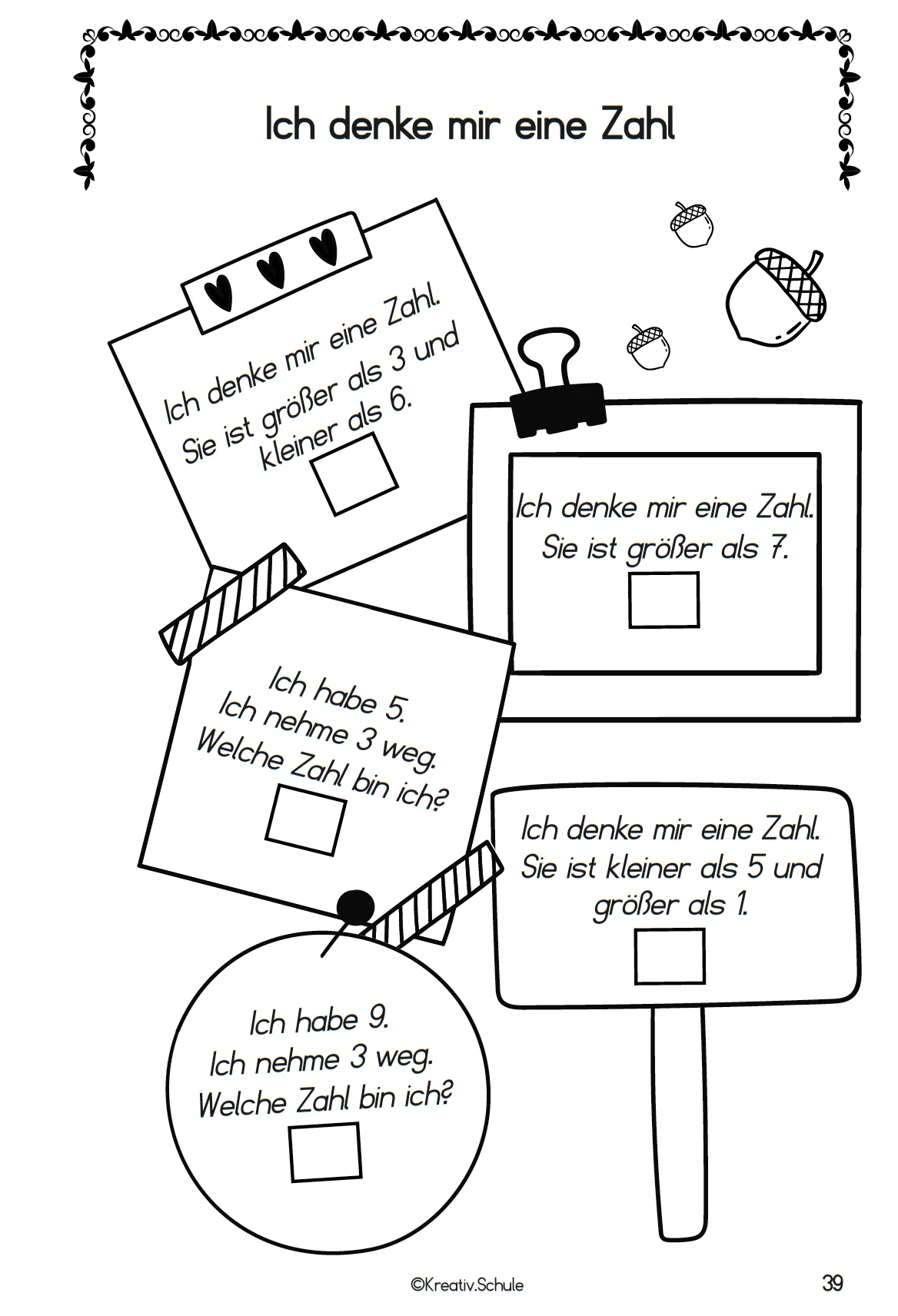
A particularly critical point is the introduction of plus and minus. For adults, this is self-evident; for children, however, it is highly abstract. The plus sign is not simply a symbol – it represents an action: "there is more". If children have not first experienced and understood this action, arithmetic remains meaningless.
That is why good learning environments first work with concrete representations, and only afterwards with symbols. This approach follows the principle of discovery learning, in which children recognise connections for themselves rather than simply being told (cf. Wittmann & Müller, 2012).
Mistakes Are Not a Sign of Weakness
Another central aspect is how we respond to mistakes. Children do not learn mathematics by getting as many answers right as possible – they learn by thinking, experimenting, and being allowed to get things wrong. Mistakes are not a sign of weakness, but a necessary part of the learning process. John Hattie shows in his widely cited meta-analysis that feedback and working constructively with mistakes have a particularly strong influence on learning outcomes (Hattie, 2009).
A good workbook must create exactly this kind of space. It guides children step by step through the number range without overwhelming them, while leaving enough room for children to develop their own ways of thinking. It shows quantities before it asks for numbers, and lets children recognise connections before it demands answers.
Because in the end, the goal is not for a child to say "5 + 3 = 8" as quickly as possible. It is for them to understand what happens when two quantities come together. To recognise why something becomes more, or less. And to begin seeing mathematics not as a set of rules, but as a comprehensible system.
Arithmetic does not begin with numbers. Arithmetic begins with understanding.
Matching materials on Eduki